
A User Guide for Working With Me
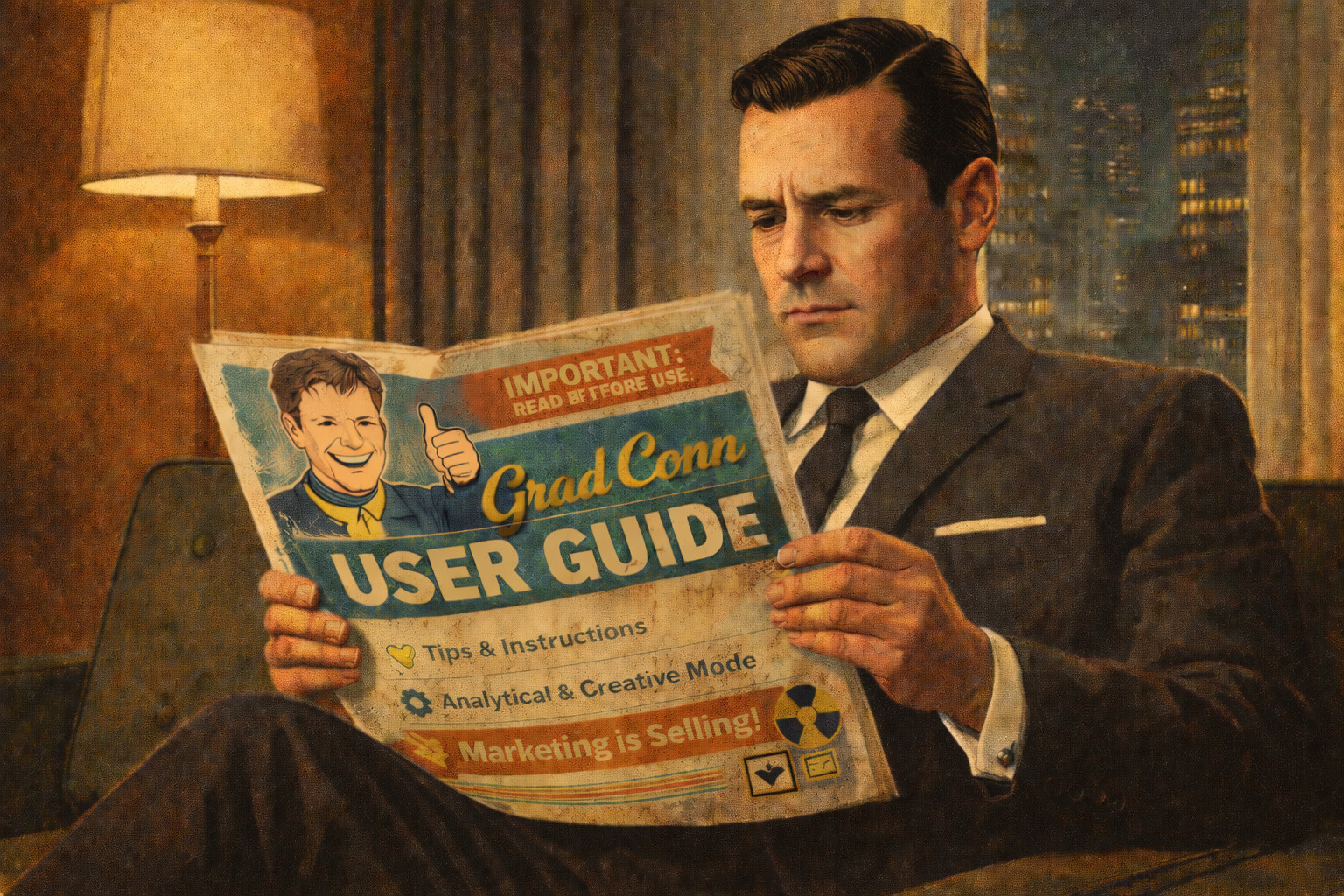
TL;DR (Executive Summary)
- Marketing is selling, at scale. If it is not driving adoption, revenue, or durable belief, it is not doing its job.
- I work in hypotheses. I prefer a point of view we can test, rather than a blank page we can admire.
- I run two tracks at once: Perform (what must work now) and Transform (what must change next).
- I’m analytical and creative. I push hard on ideas and try to be easy on people.
- I’m AI-first. I build human–synthetic teams to lift human capability, not to cosplay automation.
- I care a lot. The standards are high because the work matters, and the people doing it matter.
Author’s Note (Before You Roll Your Eyes)
I’ll start by admitting something up front: writing a “User Guide for Working With Me” feels a little awkward. It risks sounding self-referential or indulgent—like I’m narrating my own instruction manual. I don’t love talking about myself in the third person, and I’m generally suspicious of anything that sounds like personal branding for its own sake.
That said, I’ve learned—sometimes the hard way—that most friction at work doesn’t come from bad intent or lack of talent. It comes from people not quite understanding how someone else shows up, makes decisions, or defines good work.
Intensity gets mistaken for ego. Conviction gets mistaken for closed-mindedness. Creativity and rigor get treated as opposites, when in reality they are dance partners.
1. Core Beliefs (The Non-Negotiables)
1.1 Marketing is selling, at scale
I believe marketing is selling—at scale.
Not in the sleazy, pressure-filled sense. In the oldest, most professional sense of the word: understanding real human needs, making a clear case, earning trust, and persuading responsibly. Marketing is how that work scales.
If marketing is not driving adoption, revenue, or durable belief, it may be clever or creative—but it is not doing its job. Art is wonderful. I love art. Art does not, however, pay the bills.
1.2 Ideas are hypotheses, not sacred objects
I come from the Scientific Advertising tradition. That means I believe ideas should enter the room with a job to do.
- They should be testable.
- They should be improvable.
- They should be allowed to fail with dignity.
I’m happy to be wrong. I’m much less happy to start with a blank mind and call it open-mindedness. Strong hypotheses create learning velocity. Blank slates create meetings.
1.3 Creativity and rigor are complements (this is where Bernbach lives)
Claude Hopkins taught us that advertising must be accountable. John Caples taught us how persuasion works in the real world. David Ogilvy taught us standards and respect for the audience. Bill Bernbach taught us that creativity is the multiplier—and I always include him in any discussion of the greats.
Bernbach did not reject rigor. He humanized it. Data can tell you where to look, but creativity determines whether anyone cares.
The best marketing lives at the intersection of evidence and empathy, discipline and imagination, measurement and meaning. I’m deeply suspicious of any approach that worships only one side of that equation.
1.4 Categories matter more than campaigns
Campaigns perform inside markets. Categories shape how markets think.
This is why I often spend more time on framing, narrative, and coherence than on tactics. Once the mental model is right, execution compounds. When it is wrong, no amount of optimization saves you.
2. How I Operate (My Default Working Model)
2.1 I show up with a hypothesis
At the start of most meaningful efforts, I’m carrying one or two explicit hypotheses. I prefer to say them out loud, test them quickly, and revise them publicly.
You’ll hear me say things like:
- “My working hypothesis is…”
- “Here’s what would have to be true for this to work…”
- “Let’s pressure-test that assumption…”
This isn’t posturing. It’s how I think. If you want to change my mind, bring me a better hypothesis.
2.2 I run work on two tracks: Perform and Transform
I almost always separate work into two simultaneous streams:
Perform: what must work now—delivery, execution, credibility.
Transform: what must change to unlock the next phase—category, capability, operating model.
I’m rarely impressed by transformation that ignores current reality, and I’m rarely satisfied with performance that avoids deeper change.
2.3 Decisions favor clarity and momentum
I value evidence. I do not wait for perfect information. (If I did, nothing interesting would ever ship.)
My bias is to make the clearest reversible decision we can, learn quickly, and adjust deliberately. Debate is welcome before decisions. Alignment matters after.
3. How to Work With Me Day-to-Day
3.1 What tends to work well
- Clear points of view.
- Framed decisions (“the decision we need to make is…”).
- Hypotheses instead of blank-page brainstorming.
- Evidence, precedent, or lived customer truth.
3.2 What tends not to work well
- Meetings without purpose.
- Consensus theater.
- Busy work disconnected from outcomes.
- Ideas presented without context or intent.
3.3 How to read me accurately
- Challenging your idea = engagement.
- Lots of questions = interest.
- Calm tone ≠ lack of conviction.
- Intensity about the work ≠ intensity about people.
If all else fails, assume positive intent and ask. I promise I’m more reasonable in conversation than I can sound on paper.
4. AI, Humans, and Why This Matters
4.1 I am AI-first and AI-native by default
I believe AI is the biggest leverage shift since the internet—not because it replaces humans, but because it amplifies them. I do not treat AI as a side project or a demo. I treat it as a new layer of scale.
I’m a big believer in the power of AI to lift humanity—especially when it is used to remove friction, expand access to expertise, and give people more time for judgment, creativity, and care.
4.2 I build human–synthetic teams
I design teams where humans bring judgment, taste, empathy, and direction—and AI agents bring speed, pattern recognition, and execution at scale.
The goal is not automation for its own sake. The goal is lifting human capability. AI removes friction so the craft can matter more.
4.3 My bias with AI
- Start with the use case, not the tech.
- Govern before you scale.
- Measure impact, not novelty.
- Keep humans accountable for outcomes.
I’m optimistic about AI because I’m disciplined about how it gets applied.
5. Professionalism in Marketing (Why the Bar Is High)
Marketing has a lineage worth respecting: Hopkins. Caples. Ogilvy. Bernbach.
Professionalism means respecting the audience, respecting colleagues’ time, doing the work before asking for attention, and owning outcomes—not just activity.
The bar is high not because I enjoy standards for their own sake, but because I care deeply about the work—and about the people doing it.
5.1 Why I Love the Work (and Why That Shows Up as Professionalism)
I love this work.
Not in a vague, motivational-poster way, but in a deeply specific, almost old-fashioned sense. I genuinely enjoy studying persuasion. I like learning why certain ideas stick, why others vanish, and why some messages change behavior while others merely create noise. I get energy from connecting evidence, creativity, and human behavior into something that works in the real world.
That enjoyment is why professionalism matters so much to me. Professionalism is not stiffness. It is respect—respect for yourself, for your colleagues, and for the audience on the other side of the message.
Doctors do continuing medical education because the stakes are high. Lawyers study precedent because the details matter. Scientists never stop learning because reality keeps moving.
I believe marketing deserves that same seriousness. Studying the science of persuasion and the history of this craft is not extra credit. It is the job. I work best with people who care deeply about what we are doing—people who get energy from getting better, and people who want to understand why something worked rather than merely celebrating that it did.
5.2 I Care About Your Growth (and I Want You to Become a CMO)
One of the most meaningful parts of my career has been helping people grow into leaders—many of them into CMOs.
When we work together, I’m not only trying to ship campaigns or hit numbers. I’m trying to pass on a way of thinking about marketing that will serve you long after we stop working together: how to form hypotheses, how to build narrative coherence, how to make creativity accountable, how to use data without being ruled by it, and how to lead with both standards and humanity.
I want the people who work with me to leave stronger than they arrived—more confident in their judgment, more fluent in strategy and persuasion, and more capable of building teams, stories, and operating systems that compound over time.
If you want to become a world-class marketing professional—and someday a CMO—then we are aligned. I will invest in you, coach you, and push you. The push is not about control. It is about care.
6. What You Should Know for Us to Have Great Conversations About Marketing
This is not homework. It is shared context. If we are going to have high-bandwidth conversations, familiarity with these ideas helps enormously.
Foundations: Selling, Proof, and Persuasion
- Claude Hopkins — Scientific Advertising
- John Caples — Tested Advertising Methods
- Ken Roman & Jane Maas — How to Advertise
- Robert Cialdini — Influence
Craft, Standards, and Taste
- David Ogilvy — Ogilvy on Advertising
- David Ogilvy — Confessions of an Advertising Man
- Evan Thomas — The Man Who Sold America
- Bill Bernbach — study the work and the DDB philosophy (there is no single “one book” that captures him)
Ideas
- James Webb Young — A Technique for Producing Ideas
- Teressa Iezzi — The Idea Writers
- Alex Osborn — Applied Imagination
Positioning and Categories
Clarity and Thinking
You don’t need to agree with all of this. Knowing it gives us a common language.
7. Appendix: How to Have a Good Meeting With Me (Bash Edition)
If you prefer your operating instructions in code form, this section is for you. No, I do not expect you to run it.
#!/usr/bin/env grad-meeting

# Purpose: How to have a productive meeting with Grad Conn

set -o clarity
set -o intent
set -o respect_for_time

# Before the meeting
if [[ -z "$PURPOSE" ]]; then
  echo "No purpose detected. Meeting may not be necessary."
  exit 1
fi

if [[ -z "$HYPOTHESIS" ]]; then
  echo "Bring a point of view. Blank slates slow learning."
fi

# During the meeting
while meeting_in_progress; do
  challenge_ideas
  respect_people

  if [[ "$DISCUSSION" == "circular" ]]; then
    propose_decision
  fi

  if [[ "$CONVICTION" == "high" && "$EVIDENCE" == "low" ]]; then
    ask_for_supporting_data
  fi
done

# After the meeting
if [[ -z "$DECISION" && -z "$NEXT_STEPS" ]]; then
  echo "Interesting conversation. Incomplete outcome."
else
  commit_and_move
fi

exit 0
8. In Closing
If this guide resonates, we’ll probably work well together.
If it doesn’t, that is a sign too.