
Copernican Shift Series: Stop Selling Your Org Chart — A Copernican Shift in How B2B Buyers Buy
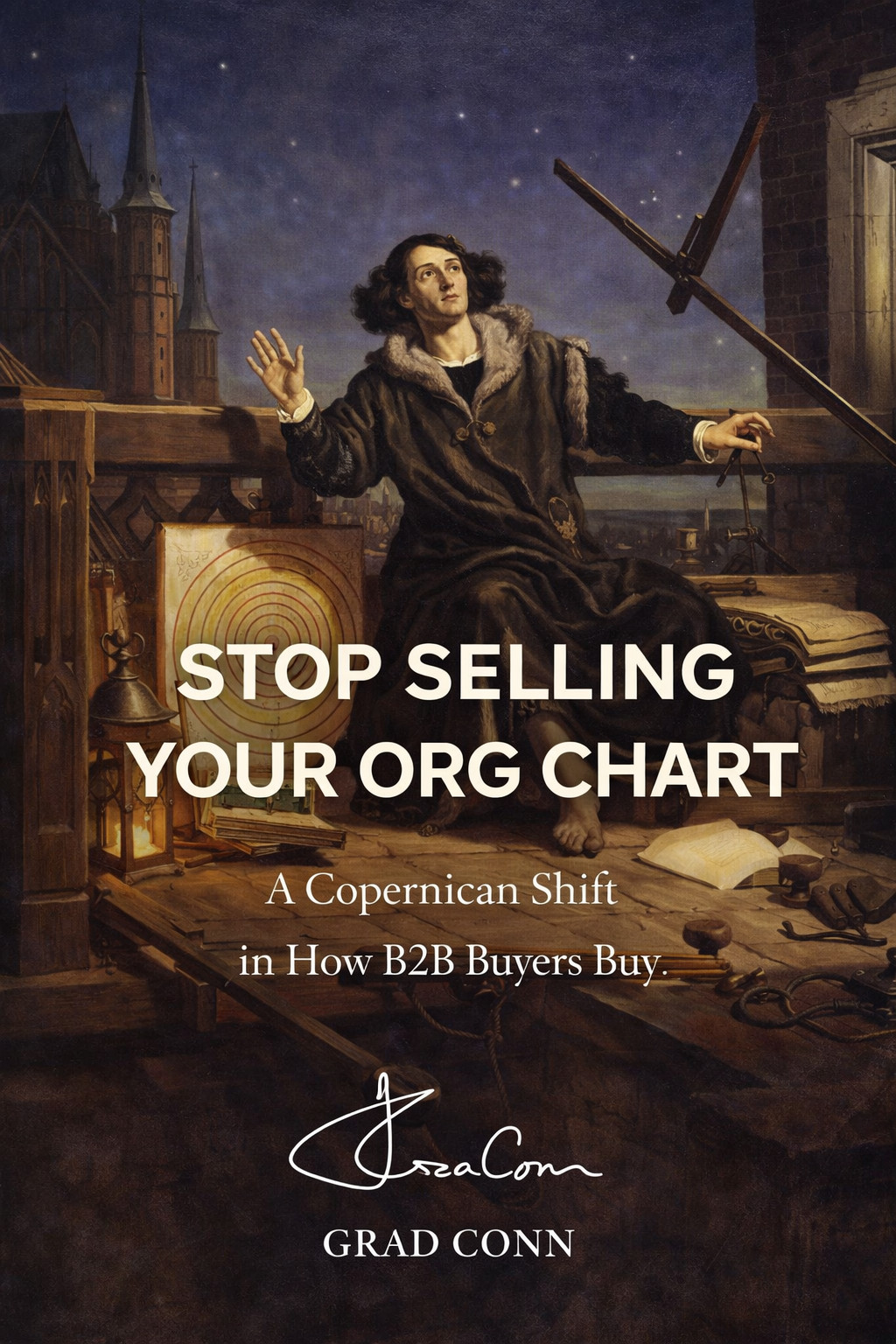
Part I: Author’s Intent + Chapter 1 (you are here)
Part II: Chapter 2 — Why Funnels Fail (coming next)
Part III: Chapter 3 — Discovery Is About Sense-Making, Not Awareness (coming after)
Part I
Author’s Intent
(Preface)
I am writing this book because something about modern B2B selling has felt increasingly dishonest to me.
Not dishonest in motive. Most people I’ve worked with in sales and marketing are thoughtful, hardworking, and genuinely trying to help their customers. But dishonest in framing. We talk about buying as if it were a process we manage, a journey we orchestrate, or a funnel we optimize. We describe progress in stages we define, measure success using metrics we invent, and diagnose failure by looking inward—at execution, alignment, or discipline.
Meanwhile, buyers experience something very different.
They experience pressure. Uncertainty. Exposure. The quiet anxiety of making a decision that will live on long after the deal closes and the excitement fades. They experience organizations as fragmented or coherent, trustworthy or slippery, human or mechanical. And they experience all of it as a single thing.
They do not experience departments.
This book is an attempt to re-center selling on that experience.
Over the years, I’ve watched organizations pour enormous energy into aligning sales and marketing, often with diminishing returns. I’ve watched new tools, new roles, and new frameworks promise to fix the problem, only to reproduce it in more sophisticated ways. And I’ve come to believe that alignment is not the missing ingredient. It is the wrong goal entirely.
The real problem is more fundamental.
We are standing in the wrong place when we observe the system.
This book argues that sales and marketing suffer from a Copernican error: we design selling models around ourselves rather than around the buyer. We mistake internal clarity for external clarity. We confuse coordination with confidence. And in doing so, we ask buyers—implicitly, repeatedly—to adapt to us.
The D3C selling model—Discovery, Create Confidence, Commit—emerged from trying to correct that error. It is not a methodology, a funnel, or a lifecycle. It is a buyer-centered way of understanding how people move from uncertainty to commitment, regardless of how we are organized internally.
This book is not written to help companies sell more aggressively. It is written to help them sell more honestly, more empathetically, and ultimately more effectively.
Because in B2B, selling is not about transactions.
It is about decisions people have to live with.
Chapter 1
Stop Selling Your Org Chart
A Copernican Shift in How B2B Buyers Buy
Every sales and marketing organization believes it is customer-centric.
That belief is almost always sincere. Teams spend enormous time refining messaging, improving handoffs, tuning funnels, and investing in tooling meant to make buying easier and growth more predictable. The intent is good. The effort is real. And yet, from the buyer’s side of the table, buying still feels harder than it should.
Conversations repeat. Context is lost. Stories subtly change depending on who is in the room. Confidence builds, then quietly erodes. Somewhere between early interest and final commitment, momentum fades—and no one can quite explain why.
Inside the organization, the diagnosis is familiar. Sales and marketing weren’t aligned. The handoff broke down. The funnel leaked. The process needs tightening.
What almost never happens is a deeper question:
From where are we observing this system?
That question is where the real problem begins.
Before Copernicus, humanity assumed the universe revolved around the Earth because that is how it appeared from where we stood. The heavens moved; we did not. The mistake was not a lack of intelligence or rigor. It was perspective. We mistook the observer for the center.
Modern go-to-market thinking makes the same mistake.
We build selling models by observing ourselves. Our departments. Our stages. Our metrics. Even our most earnest attempts at customer centricity often amount to projecting our org chart outward and calling it a journey. We describe buying in the language of how we operate, then wonder why buyers behave unpredictably inside those models.
The buyer experiences none of this.
From their perspective, there is no marketing department and no sales department. There is no funnel, no lifecycle, no stage gate. There is only a company—encountered through a series of interactions—asking them to make a decision that carries real consequences.
The buyer is not trying to move through your process.
They are trying not to make a mistake.
That distinction matters more than most selling models are willing to admit.
B2B buying is often described as rational, analytical, and unemotional. That description is comforting. It allows us to believe that better information, better demos, or better ROI models will carry the day.
It is also wrong.
B2B buying is accountable. A poor consumer purchase might be annoying. A poor business decision can threaten credibility, reputation, and career trajectory. It can quietly reshape how someone is seen inside their organization, long after the deal closes and the excitement fades.
The consequences do not stay neatly contained inside a quarterly forecast.
They spill outward into real life.
Every buying decision is a career decision.
Some just take longer to reveal it.
Seen from this vantage point, many familiar go-to-market problems take on a different meaning. Deals do not stall because sales failed to close or marketing failed to generate demand. They stall because confidence was never fully earned. Friction appears not because the process is inefficient, but because the buyer is unconvinced it is safe to proceed.
And yet, our response is almost always the same.
We look inward.
We try to better align teams the buyer cannot see.
Alignment feels productive because it is measurable. Ownership can be clarified. SLAs can be defined. Dashboards can be built. Alignment creates the sense that the system is under control. But alignment assumes the structure itself is correct and merely needs coordination.
That assumption is rarely questioned.
Alignment is an internal objective. Buying is not.
The buyer does not care whether a message came from marketing or sales. They care whether it makes sense. They do not care who owns the account at a given moment. They care whether the company understands the constraints they are operating under and the risks they are absorbing.
When organizations optimize for alignment instead of empathy, they make the system cleaner for themselves while leaving the buyer to do the hard work of stitching the experience together.
This is what it means to sell your org chart.
Selling your org chart does not require explicitly explaining how your teams are structured. It happens implicitly, whenever buyers are asked to reconcile inconsistent narratives, remember what was promised earlier, or navigate shifting responsibilities without context. The more complex the organization, the more effort this demands of the buyer—and the more confidence quietly erodes.
The Copernican shift required in modern B2B selling is not better alignment between sales and marketing.
It is a change in vantage point.
When you stop asking how sales and marketing should work together and start asking what the buyer needs in order to move forward, a different pattern emerges. That pattern is what led to the D3C selling model.
Discovery: How Buyers Make Sense of Their World
Every buying journey begins before the buyer is ready to buy.
Something feels off. A constraint is tightening. Complexity is increasing. A system that once worked no longer does. At this stage, buyers are not looking for solutions. They are looking for clarity. They are trying to understand whether the problem they sense is real, whether it matters, and whether it is worth addressing now.
From inside the organization, this phase is often labeled awareness or demand generation. From the buyer’s perspective, it is something much more fundamental: sense-making.
Discovery is not about visibility. It is about articulation.
Buyers do not want to be told what you sell. They want help naming what they are experiencing. When organizations rush to sell at this moment, buyers feel pushed. When organizations help buyers make sense of their situation—often better than they can themselves—trust begins to form.
This is why Discovery is so often mishandled. It is tempting to assume intent that does not yet exist. It is tempting to introduce solutions before the problem has been fully understood. But premature selling at this stage feels tone-deaf, because it centers the seller’s urgency instead of the buyer’s confusion.
When Discovery works, buyers feel understood before they feel persuaded. And once that happens, the rest of the journey becomes possible.
Create Confidence: Where Deals Are Actually Won or Lost
If Discovery is about making sense of a problem, Create Confidence is about living with the decision to solve it.
This is the phase most organizations misunderstand, and the one where the emotional reality of B2B buying becomes unavoidable. From the inside, Create Confidence is framed as evaluation—proof points, demos, references, security reviews, pricing discussions. Important, yes, but incomplete.
From the buyer’s perspective, something much heavier is happening.
They are internalizing the consequences of being wrong.
This is where Bob Kocis’s The President’s Club Mindset captures something most frameworks avoid: elite selling is grounded not in persuasion, but in empathy. The best sellers understand what the buyer is carrying emotionally and professionally into the decision—and they know how to respond to it.
That emphasis is often dismissed as softness. It is anything but.
Empathy at this stage is not about being nice. It is about recognizing that B2B buying is deeply emotional precisely because it is accountable. Buyers may never say it out loud, but they are running the scenario anyway. If this goes wrong, what happens to me?
In the darker version of that story—the one people joke about because it is uncomfortable to name—you lose the whole country song. You lose the job. You lose the house. You lose the college fund. You lose the marriage. The specifics vary, but the fear is real.
This is why Create Confidence is not about convincing someone that your software works.
It is about convincing them that you will be there when things don’t.
At this stage, buyers are no longer asking whether your product is impressive. They are asking whether you are trustworthy under pressure. Whether you will show up when something breaks. Whether you will stand beside them when the decision they champion is being questioned.
No amount of feature differentiation compensates for failing that test.
This is also where selling your org chart becomes most dangerous. When marketing tells one story and sales tells another—even subtly—buyers feel exposed rather than supported. When early promises soften later, confidence erodes. When process replaces empathy, buyers sense distance exactly when they need reassurance.
Create Confidence is about risk absorption. It is about signaling, through consistency and behavior, that the buyer is not alone in the decision they are about to make.
When it works, buyers do not say, “This is the best product.”
They say, “I trust these people.”
That trust is what allows them to move forward and live with the decision afterward.
Commit: Living With the Decision
Commit is often described as closing, but that framing once again centers the seller instead of the buyer.
From the buyer’s perspective, commitment is not a moment. It is a transition. They have crossed a threshold, and now they must live with what follows. Implementation, onboarding, early value, and support all become part of a single emotional arc: reassurance.
This is where buyers look for confirmation that they made a good choice. Not in theory, but in practice. Small signals matter here. Responsiveness. Accountability. The absence of surprise. The feeling that the company is still present now that the contract is signed.
When Commit is mishandled, even a closed deal feels fragile. When it is handled well, momentum builds naturally, and confidence compounds over time.
Once again, the buyer does not care which department owns which part of this phase. They care that the experience feels intentional and human.
Re-centering the System
D3C—Discovery, Create Confidence, Commit—is not a funnel, a lifecycle, or a methodology. It is a buyer-centered way of understanding how people move from uncertainty to commitment.
Marketing and sales both participate in all three phases. They simply do so in different ways and at different scales. The buyer does not experience those distinctions, and the model deliberately refuses to honor them.
This is why marketing is selling at scale. Not as a provocation, but as a symmetry.
This book is not about improving coordination between departments. It is about re-centering the entire go-to-market system on the buyer’s lived experience.
When you stop selling your org chart and start designing for empathy, many of the problems that plague modern B2B selling begin to resolve themselves. Messaging clarifies. Confidence becomes easier to earn. Growth becomes less fragile.
That is the Copernican shift this book is about.