
THROWBACK THURSDAY (Thanksgiving Edition): Happy Franksgiving 2026!
Here’s my annual Thanksgiving/Franksgiving post, which I love to resurrect every year as a reminder that political partisanship is not something we invented in the 21st century. Without further ado, here we go with this year’s edition of Franksgiving.
Many years ago, I was watching one of my favorite movies, Holiday Inn, the 1942 film starring Bing Crosby and Fred Astaire, when I noticed a little joke I didn’t understand. A cartoon turkey appears on a November calendar, jumps back and forth between two Thursdays, and finally gives up and shrugs at the audience. Clearly, this was supposed to mean something. I wanted to know what I was missing.
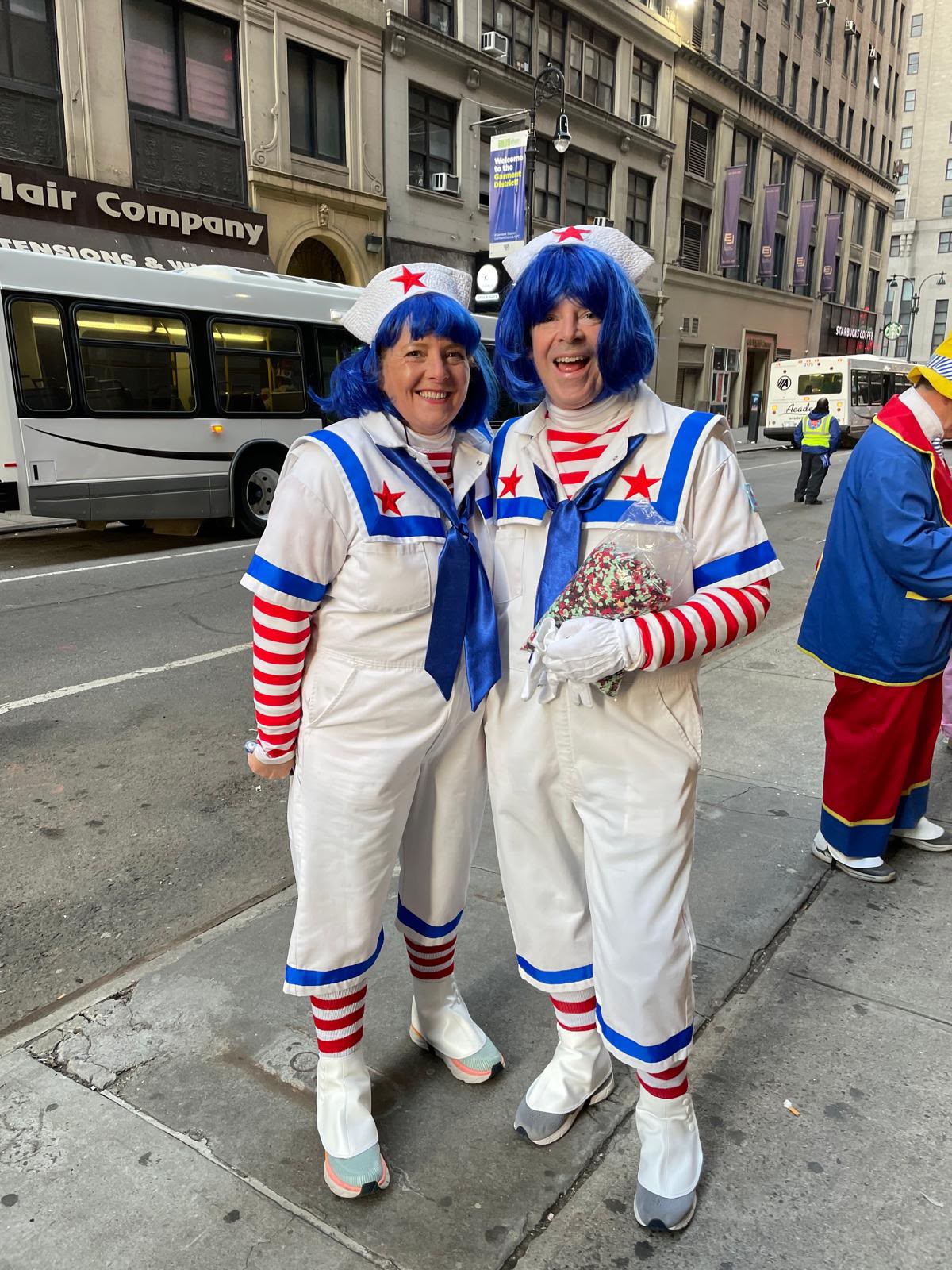
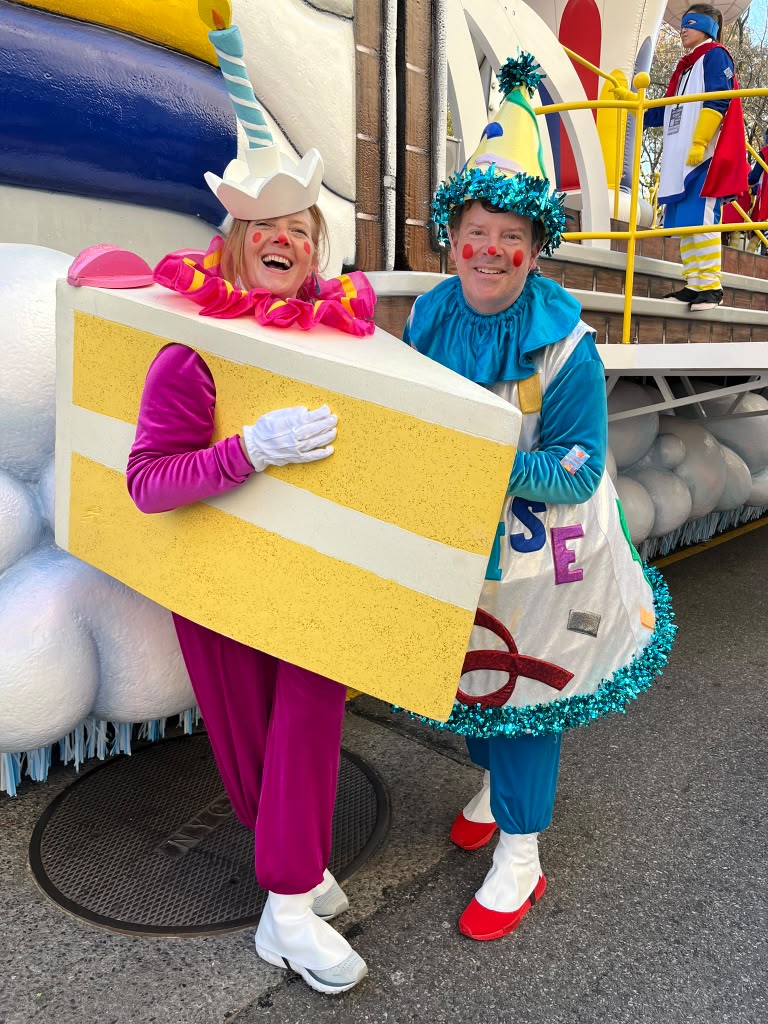
More recently, Rachel and I have been in the parade twice: once in 2021 as Silly Sailors, and again the following year, 2022, as Cake Clowns. Those mornings gave me a rather different view of what happens when people gather for a holiday. This year, with Macy’s Thanksgiving Day Parade postponed until Saturday, the calendar has supplied another reason to revisit the story.
Table of Contents
- Why the turkey keeps moving
- A partisan Thanksgiving
- Macy’s goes to the movies
- This year, the parade moves to Saturday
- Silly Sailors, Cake Clowns, and confetti
Why the turkey keeps moving
By 1939, Americans had become accustomed to celebrating Thanksgiving on the last Thursday of November, following a tradition associated with Abraham Lincoln’s 1863 proclamation. Unfortunately for retailers, November had five Thursdays that year, which put Thanksgiving on November 30. Most Christmas shopping happened after Thanksgiving, so a late holiday meant a shorter selling season. With the country still recovering from the Depression, retailers wanted another week.
Their request had some history. Business groups had asked Franklin Roosevelt to move Thanksgiving in 1933, another year in which the last Thursday fell on November 30. He had declined. In August 1939, however, he announced that he would move the holiday forward, and his eventual proclamation designated November 23. The reasoning was straightforward enough: give people more time to shop, and perhaps they would spend more money. The National Archives’ account of the experiment describes years of lobbying behind what otherwise looks like a sudden presidential interest in dinner arrangements.
The difficulty was that other people had already made arrangements of their own. Calendars had been printed. Schools had scheduled vacations. Football games had been organized around the expected holiday. Some governors followed Roosevelt’s new date; others kept the old one. The FDR Presidential Library describes families in New York and Connecticut discovering that they no longer had the same day off. A holiday intended to bring people together had become considerably less convenient for doing so.
That is the part of the story I find more interesting now. To the retailers, Thanksgiving marked the beginning of a selling season. To a family with relatives across a state line, it was the day everyone was supposed to be available. Moving a date on the President’s calendar was considerably easier than moving all the lives arranged around it.
A partisan Thanksgiving
The change acquired the derisive name “Franksgiving,” and Americans brought their political loyalties to the discussion with considerable enthusiasm. Gallup’s account of its 1939 polling reports that, among respondents expressing an opinion, 52 percent of Democrats supported the change while 79 percent of Republicans opposed it. Apparently, even the appropriate Thursday for eating turkey could be determined by how you had voted in the last presidential election.
Alf Landon, Roosevelt’s Republican opponent in 1936, complained that the President had sprung the change on the country “with the omnipotence of a Hitler.” That wording appears in George Gallup’s original August 1939 report. There were reasonable objections to the disruption, which makes the leap from a scheduling complaint to Hitler all the more spectacular. People did not need social media to get there.
Congress eventually settled the date. On December 26, 1941, Roosevelt signed legislation establishing the fourth Thursday in November as Thanksgiving, beginning the following year. The fourth Thursday is usually the last Thursday, but in a five-Thursday November it leaves retailers their additional week. The National Archives has the congressional documents. This was the settlement of Thanksgiving’s recurring date; the holiday itself had a much longer history.
When Holiday Inn appeared in 1942, its audience had just lived through this argument. The turkey’s indecision required no explanation. Decades later, I needed to go looking for the joke.
Macy’s goes to the movies
Retailers had been helping shape Thanksgiving well before Roosevelt moved it. The first Macy’s parade took place on November 27, 1924, and was originally called Macy’s Christmas Parade, despite being held on Thanksgiving. According to the Library of Congress, employees organized it to encourage holiday sales and draw attention to the store. Macy’s own history describes bringing Santa to the store to unveil its Christmas windows. Thanksgiving was a useful moment to tell New York that Christmas had arrived.
Then the movies helped make that moment familiar far beyond the parade route. Miracle on 34th Street, released in 1947, begins with the Macy’s Thanksgiving Day Parade and a problem with its Santa Claus: he is drunk. Kris Kringle steps in, which eventually leads to his employment as the store’s Santa. One of the great Christmas movies begins with someone trying to get a Thanksgiving event through an unexpected staffing problem.
Some of what we see is the actual 1946 parade. Director George Seaton filmed amid the festivities on November 28, and Edmund Gwenn rode the real Santa Claus float. In TCM’s account of the production, Maureen O’Hara recalls the scramble to capture scenes when the parade could not be stopped for another take. The people watching Santa that morning were watching the actor who would become Santa for generations of movie audiences. They just didn’t know it yet.
The film also gives the store a useful education. Kris sends parents elsewhere when Macy’s cannot supply the toys their children want. Management initially considers this grounds for dismissal, until a grateful customer explains that it is precisely why she intends to return. For a few uncomfortable minutes, helping a customer have a successful Christmas looks like a violation of sales policy. The American Film Institute’s synopsis captures the sequence beautifully.
The 1994 remake keeps the parade opening but substitutes fictional Cole’s for Macy’s, which declined to participate. I’ve written before about the pleasure of returning to familiar movies, and Christmas gives us an entire season in which repetition is welcome. We know the story, remember the scenes, and look forward to seeing them again. Sometimes those movies also connect us to people who loved them.
For Rachel, Miracle on 34th Street has that connection. It was her mother’s favorite movie, and Rachel had always wanted to be in the parade.
This year, the parade moves to Saturday
As I write this on Thanksgiving, November 26, 2026, Macy’s 100th parade is scheduled for Saturday, November 28, at 8:30 a.m. Eastern, after severe weather forced a postponement. It is the first weather postponement in the parade’s history. There have been cancellations before: the parade did not take place in 1942, 1943, or 1944 during World War II. The distinction matters, especially in a post about how easily the history behind a familiar holiday gets compressed.
NBC is showing the 2025 parade on Thanksgiving morning, with this year’s event still to come. There is something fitting about that arrangement after all those years of watching old Christmas movies: the screen can keep the familiar ritual on schedule while the people responsible for the live event work out what happens next.
The reasons for moving the parade are very different from Roosevelt’s reasons for moving Thanksgiving. But the disruption makes the number of people behind an apparently fixed tradition visible again. Once you have participated, you have some appreciation for how much has to happen before everyone can simply turn on the television and enjoy it.
Silly Sailors, Cake Clowns, and confetti
Rachel and I finally got to be in the parade in 2021, dressed as Silly Sailors. For her, it was something she had wanted to do for years, with her mother’s favorite movie somewhere in the history of that wish. Getting to share it with her was a peak experience and one of the great moments of our relationship. I am very glad we did it, although my right knee might have preferred a different year.
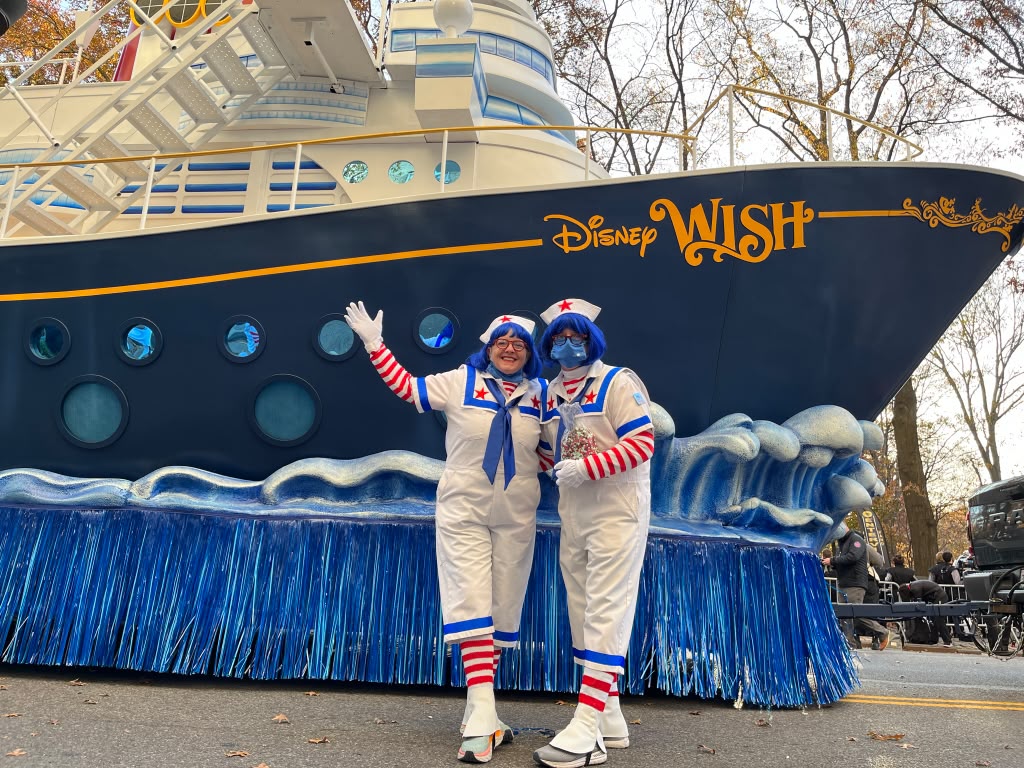
I had recently undergone ACL surgery, and I remember my doctor’s eyes widening when I told him I was going to be in the parade. What I had failed to understand was how much of the route you spend practically running. If I had known that beforehand, I probably would not have attempted it. I honestly don’t know how I made it through, but I did, and I’m fine now. His expression made considerably more sense once we were underway.
One of the things you receive as a clown is a bag of confetti to throw toward the crowd. This turns out to be an extraordinarily enjoyable activity for everyone involved. People want to be confettied. They are delighted that you have come over to do it, and their delight makes you want to keep going. Of all the things I could have expected to learn that morning, the popularity of having paper thrown at you was probably not near the top of the list.
When we returned in 2022, dressed as Cake Clowns, we were better prepared. We brought our own confetti, including extra bags, so we could do more of the thing everyone seemed to enjoy. There are few occasions in adult life when dressing as a Cake Clown and carrying additional confetti counts as being better prepared, so I recommend appreciating them when they occur.
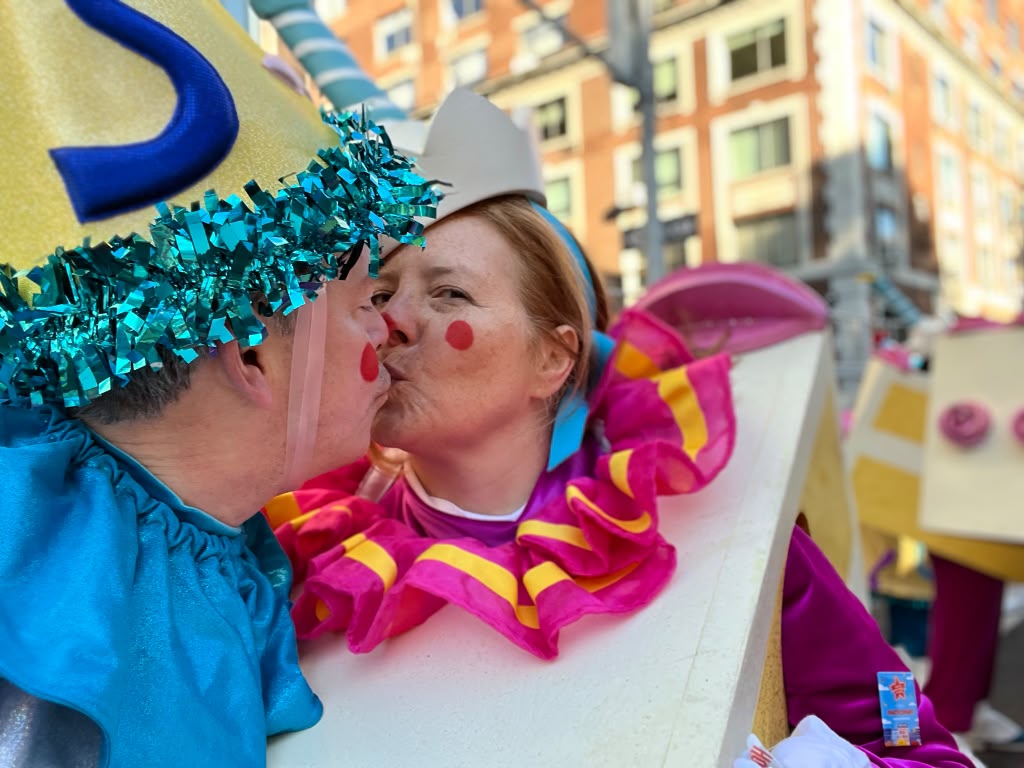
What stays with me, though, is the amount of joy along that route. There is excitement, of course, but there is also an extraordinary love and generosity in people’s faces. They are happy to be part of it, and that happiness includes the strangers around them. You are helping make the morning enjoyable for them, and their response makes it one of the best mornings of your own life.
We spend a lot of time talking about the world in negative terms, and there is plenty to struggle with. I think about those parade mornings because I have also seen people simply loving the experience of being people together. If you want to see humans at their best, put them along a parade route, dress up as a clown, and throw confetti at them. It is an experience I wish more people could have.
We weren’t going to be in this year’s parade, but the postponement has scrambled plans for volunteers, and Rachel and I are hoping there might be a way to help on Saturday. Nothing is settled yet. There may be another parade in our immediate future, which would be a lovely addition to a Thanksgiving story that began, for me, with a confused cartoon turkey.
In the meantime, have a good dinner. And if we do make it back into the parade, I’ll remember the extra confetti.