
AI Has a Marketing Problem. Here’s the Solution.
AI is getting booed at commencement ceremonies, which is a strange sentence to write and a useful one. Commencement speeches are usually designed to be politely endured. The speaker tells the graduates that the future is bright, the parents take too many pictures, and everyone tries not to think about the parking lot after the ceremony, or the excessive sun exposure they are enduring. It is not generally a hostile environment unless someone says something truly foolish, mispronounces too many names, or goes long enough for the audience to begin checking real estate listings in the next town.
This year, several commencement speakers got to AI and the room turned on them. At the University of Arizona, former Google CEO Eric Schmidt was booed while talking about AI’s impact on nearly every profession. At the University of Central Florida, Gloria Caulfield, a Tavistock executive, was booed after calling AI “the next industrial revolution.” At Middle Tennessee State University, Big Machine Records CEO Scott Borchetta was booed after saying that AI was rewriting production and then telling students to deal with it. Glendale Community College had a more literal version of the same problem when an AI system used to read graduates’ names malfunctioned and drew boos from the audience. Apparently nothing says “celebration of individual achievement” quite like outsourcing the pronunciation of your name to a system that cannot get through the program. Source: Associated Press.
By the following weekend, the story had escaped the campus quad and become culture. Saturday Night Live picked it up on Weekend Update, which is a useful marketing signal. By the time a business problem becomes an SNL joke, it has usually moved beyond the trade press and into shared public understanding. The joke works because the audience immediately recognizes the pattern: a speaker says “AI,” and the graduates boo. Here is the SNL Weekend Update segment on YouTube.
The important point is not that students are anti-technology. That explanation is too easy, and easy explanations are often where thought goes to retire. Gallup found that about half of Gen Z uses generative AI at least weekly, even as their excitement and hopefulness about AI have fallen and their anger has increased. The people booing are not necessarily refusing to use the tool. They are refusing the story being told about the tool. Source: Gallup.
The people booing are not refusing the tool. They are refusing the story being told about the tool.
That is the useful clue. The backlash is not just about AI capability. It is about AI hierarchy. People are not only asking whether the machine can do more. They are asking whether the machine is being placed above them, around them, or in service of them. The AI industry has spent the last few years answering that question badly, mostly by showing another thing humans used to do that a machine can now do faster, cheaper, and with the kind of investor-deck enthusiasm that makes normal people check where the exits are.
The better answer is not to pretend AI is small. It is not small. The better answer is to put it in the right relationship to human intelligence. AI should not be the sun. Human intelligence should be the sun. AI should be a satellite: useful, powerful, mission-driven, and valuable because it extends the reach of the human center.
Table of Contents
- The backlash has moved into the workplace
- The story is landing badly because the hierarchy is wrong
- This is Crossing the Chasm with GPUs
- HI is the missing category
- AI is built from HI
- Wozniak put the machine back in orbit
- The humanity question is not sentimental
- The Luddites were not asking the wrong question
- What AI should actually take
- The HI + AI adoption test
- Move the center of gravity back to HI
The backlash has moved into the workplace
The commencement backlash would be easier to dismiss if it were only a campus story. It is not. In the days since I first started working through this piece, the negative AI narrative has kept getting stronger, especially in the reporting around layoffs and reorganizations at Meta and Cloudflare. That matters because the AI fear story is no longer hypothetical. People are watching large companies describe AI not only as a new tool, but as the organizing logic for fewer roles, flatter structures, forced transfers, and new forms of measurement.
Cloudflare is the cleanest example because the company said the quiet part with unusual clarity. In a May 7 note to employees, Cloudflare announced that it would reduce its workforce by more than 1,100 employees globally. In the same note, the company said its usage of AI had increased by more than 600% in the previous three months and that it was reimagining “every internal process, team, and role” for the agentic AI era. Reuters described the cuts as about 20% of Cloudflare’s workforce as the company restructures operations around the rapid adoption of AI tools. Source: Cloudflare. Source: Reuters.
Meta has been telling a related story at a much larger scale. Reuters reported that Meta laid off 10% of its workforce globally while transferring 7,000 employees to new initiatives related to AI workflows, with the total layoffs and transfers affecting about 20% of the company’s workforce. Reuters also reported that employees reacted skeptically when Mark Zuckerberg told them he did not expect more “company-wide” layoffs this year, with some employees focusing on the careful wording of “company-wide” and “expect.” That is not a workforce that feels reassured. That is a workforce reading the memo the way experienced employees read corporate language: slowly, suspiciously, and with a small internal legal department they did not know they had. Source: Reuters and Source: Reuters.
The machine got promoted and the humans got a severance FAQ.
This is the AI alibi problem. Executives may believe they are explaining strategy. Employees hear a different sentence: the machine got promoted and the humans got a severance FAQ. Even Jensen Huang, who is not exactly running an anti-AI knitting circle, criticized CEOs who blame AI for layoffs as a “lazy” narrative and said the industry is scaring people. That is a useful warning because it comes from someone with every incentive to sell the upside of AI. Source: Business Insider.
This does not mean every layoff attributed to AI is actually caused by AI. Some companies may be using AI as an all-purpose explanation for cost-cutting they wanted to do anyway. The phrase “AI-driven restructuring” can do a lot of work in a board deck, especially when “we overhired, under-managed, and now need Wall Street to believe we have discovered discipline” feels a little wordy. But for the public narrative, the distinction barely matters. If AI is repeatedly introduced through layoffs, forced reassignments, and surveillance-adjacent workflow changes, people will not experience AI as an extension of their agency. They will experience it as management’s new favorite weather system.
The story is landing badly because the hierarchy is wrong
The dominant AI story has been told as a capability story. Can AI write the ad? Can AI make the image? Can AI pass the test? Can AI summarize the meeting, analyze the data, build the deck, write the code, draft the legal memo, produce the video, answer the customer, and generate the campaign? The industry has spent the last few years demonstrating another thing humans used to do that machines can now do faster, cheaper, and at scale.
That may be an impressive engineering story. It is a terrible adoption story. It turns every product demo into a performance review.
71% of Americans think AI development is moving too fast.
— YouGov
You can see the problem in the data. YouGov found in May 2026 that 71% of Americans think AI development is moving too fast, and that twice as many Americans are pessimistic as optimistic about AI’s long-term impact on society. Quinnipiac found that 70% of Americans think advances in AI are likely to decrease job opportunities, with Gen Z the most pessimistic age group. Stanford HAI’s 2026 AI Index reported that 64% of Americans expect AI to lead to fewer jobs over the next 20 years, while only 5% expect more. Those numbers are not the sound of a market being reassured. Source: YouGov. Source: Quinnipiac University Poll. Source: Stanford HAI.
I did a directional scan of recent AI coverage while working on this piece. This is not a formal media analysis, and I would not put it in a peer-reviewed journal unless peer review has had a much rougher year than I realized. I am not presenting this as a formal content analysis. It was a working read of roughly thirty recent articles, polls, and reports while writing this piece. But the pattern was useful from a marketer’s perspective. The 2:1 negative coverage clustered around jobs, trust, creative rights, data centers, energy use, regulation, surveillance, and whether ordinary people have any meaningful say in how AI enters their lives. The positive coverage tended to focus on productivity, faster task completion, better search, medical use cases, and executive optimism. In other words, the upside story is being told as efficiency, while the downside story is being felt as identity.
That is a bad trade. Efficiency is something managers like. Identity is something people defend. When the two are placed in opposition, efficiency may win the budget, but it usually loses the room.
This is Crossing the Chasm with GPUs
There is a familiar technology-marketing problem hiding inside the AI backlash. Geoffrey Moore’s Crossing the Chasm describes the challenge of moving from early adopters to mainstream customers. Early adopters buy vision. Pragmatists want proof, use cases, references, and some confidence that the new thing will make their world better rather than merely make someone else’s spreadsheet prettier. Source: Geoffrey A. Moore.
AI is running into that chasm now. Technologists are still talking like technologists. They talk about models, benchmarks, agents, GPUs, latency, context windows, multimodality, reasoning, and costs per token. There is nothing wrong with that language inside the early market. It is useful, precise, and often necessary. But the mainstream market is asking a different question: what happens to me?
That is the question AI marketing has not answered well enough. Do I become more capable, or less necessary? Do I get more control over my work, or does someone else get a more efficient way to measure and replace me? Am I being handed a tool, or am I being shown my successor?
The industry’s default answer has been, “Look what AI can do now.” The better answer is, “Look what human intelligence can do now that it has AI to work with.”
That is the shift.
HI is the missing category
The phrase we have not spent enough time with is human intelligence. We talk constantly about AI, but HI is mostly treated as the background condition. It is assumed, unnamed, and therefore easy to discount. That is a strange omission from a technology industry that can usually name a feature, acronymize it, turn it into a category, and schedule a conference track before lunch.
Human intelligence is not a slower version of artificial intelligence. It is a different kind of intelligence with a different role. HI carries intention, judgment, memory, taste, empathy, moral responsibility, audience understanding, and lived experience. It knows why something matters, not merely what pattern is statistically likely to come next. It understands that a technically correct answer may still be the wrong answer for a customer, a company, a culture, a moment, or a promise. This is the part of work that business writing often calls “soft,” usually right before discovering that it is the hardest part.
Artificial intelligence contributes something different. AI offers speed, range, recall, synthesis, variation, structure, counterargument, translation, simulation, and first-draft momentum. It can generate options, summarize sources, compare alternatives, find inconsistencies, and help a person see the shape of a topic faster. It is very good at producing raw material and reasonably good at organizing it. It is not good at knowing, by itself, what should matter.
The useful equation is HI + AI = 3. That is not consultant math, although consultant math has certainly done worse. It means the combination should produce something neither side would produce alone. HI supplies the purpose, taste, judgment, context, and accountability. AI supplies speed, scale, variation, and executional support. The value is not in pretending the two are equivalent. The value is in understanding the relationship between them.
AI is built from HI
There is a deeper point here that should be central to the story. AI is based on HI. Artificial intelligence is not alien intelligence. It did not arrive from outside the human system with a mind untouched by human life. Modern generative AI is built from the accumulated traces of human intelligence: language, code, images, arguments, explanations, jokes, designs, documents, classifications, and all the other ways people have tried to make sense of the world and communicate that sense to one another.
That means AI is not outside the human story. It is made from the human story. It is aggregate intelligence built from the residue of individual intelligence. That is its power, and it is also its limitation.
Human beings are not collective minds. That is one of our constraints. My mind is inside my life, and yours is inside yours. We cannot simply connect our consciousnesses, merge our memories, or download one another’s experiences, which is probably for the best given what most of us have stored in there. Instead, we use language, art, mathematics, music, software, ritual, commerce, and story to pass fragments of ourselves across the distance between us.
But individuality is also our strength. A human being is not a dataset. A human being is a point of view formed by a body, a history, a family, a culture, a set of loyalties, a set of wounds, a memory, a conscience, and a finite amount of time. Human intelligence is situated. It has stakes. It makes decisions under conditions of uncertainty and consequence. AI can synthesize patterns from the collective, but it does not become an individual in the human sense. It can imitate the language of experience because humans have described experience so richly. Imitation is useful. It is not incarnation.
AI is a satellite made from reflected human light.
That is why HI must remain the center of gravity. AI can recombine what human beings have expressed, but it does not have a life from which meaning arises. It can generate plausible answers, but it does not own the consequences of choosing one. It can produce output, but it does not know why this customer, this promise, this risk, this audience, this moment, or this decision should matter.
That is the right relationship. Useful, powerful, and worth sending into orbit. But not the sun.
Wozniak put the machine back in orbit
This is why Steve Wozniak got the room right when so many others got it wrong. At Grand Valley State University, he reportedly received laughs and applause after telling graduates that they already had AI: “actual intelligence.” It was a good line because it was funny, but it worked because it restored the hierarchy. Wozniak did not deny artificial intelligence or pretend it would be irrelevant. He reminded the people in the room that human intelligence was still the point of the exercise. Source: Business Insider.
That is the story AI needs. The industry should stop leading with the claim that AI can do what humans do. In some narrow cases, that claim is true. It is also often beside the point. Asking people to celebrate a future in which their value is continuously benchmarked against a machine is poor adoption marketing. It is also an odd way to build enthusiasm, unless the goal is to make every user feel like the “before” picture in a consulting deck.
The better story is that AI gives more people access to a layer of synthetic capacity. A solo founder can have something like a research assistant, copy assistant, financial analyst, and presentation helper, without having to find four people willing to accept equity and cold pizza as a compensation philosophy. A junior marketer can explore a market landscape faster. A strategist can test an argument against several plausible objections before walking into the meeting. A designer can generate twenty rough directions so the good one arrives earlier. An analyst can spend less time cleaning and summarizing data and more time interpreting it. A writer can get past the blank page without surrendering the voice, which is helpful because the blank page has always been a smug little tyrant.
This is the orbital metaphor in practical terms. HI is the center of gravity. AI extends its reach.
The humanity question is not sentimental
The contrast between HI and AI is not merely a contrast between two forms of intelligence. It is a contrast between two kinds of being in the work. Human beings are not just better at some tasks and worse at others. That framing is too brittle because the task boundary will keep moving. The stronger point is that human beings bring individuality, responsibility, and meaning to work in a way artificial intelligence does not.
That matters because the backlash is not only about economics. It is about dignity. When workers see AI tied to layoffs, forced transfers, keystroke tracking, and flattened organizations, they are not only asking whether their current task list can be automated. They are asking whether the company still sees them as people with judgment, memory, relationships, taste, and responsibility, or as a bundle of functions waiting to be optimized. “Bundle of functions waiting to be optimized” may not be the official HR phrase yet, but give it a quarter.
This is why the humanity frame can strike a chord if it is handled carefully. It cannot be fake uplift. People do not need another poster about “the human touch” taped to the wall during a reduction in force. They need an operating model that proves human intelligence is still the center of the system. That means naming the human role clearly: humans set the mission, own the judgment, carry the ethics, understand the customer, read the room, make the tradeoffs, and remain accountable for the outcome.
AI should be contrasted with humanity not because humanity is a decorative brand value, but because humanity is the governing requirement. If the machine produces infinite options, the human must know which option deserves to exist. If the machine drafts the message, the human must know whether the message should be sent. If the machine accelerates the workflow, the human must know whether the workflow is worth accelerating. If the machine can imitate empathy, the human must still be responsible for care.
That is not anti-AI. It is the condition under which AI becomes useful rather than threatening. AI earns trust when people can see where human judgment remains in command. Without that, the category starts to look less like a tool and more like a transfer of agency from workers to systems.
The Luddites were not asking the wrong question
The historical parallel is not “people always fear new technology.” That is the bumper-sticker version of history, and bumper stickers are not known for their nuance. The more useful Luddite story is about deployment, power, and control.
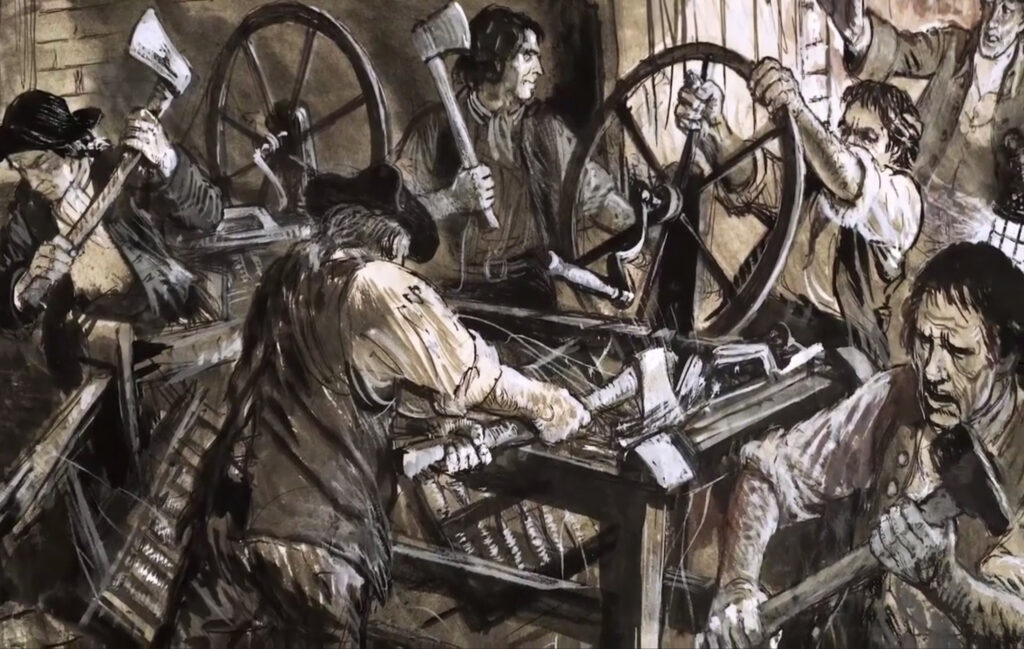
We use “Luddite” today as an insult for someone who hates technology, but the historical Luddites were skilled textile workers responding to machinery that threatened their livelihoods, wages, craft standards, and bargaining power. Smithsonian’s account is especially useful because it notes that the Luddites were not simply against machines. They objected to the way certain manufacturers used machines to get around standard labor practices and undermine skilled work. Source: Smithsonian Magazine.
That distinction matters. People do not usually resist tools in the abstract. They resist arrangements that make them less powerful. The machine is not the only issue. The operating model around the machine is the issue.
That is the lesson for AI. If AI is introduced primarily as a headcount-reduction tool, people will resist it. If it is introduced as a surveillance layer, people will resent it. If the internal message is “we need to do more with less,” employees will understand the sentence perfectly. They have heard it before. It rarely means less work.
What AI should actually take
The better deployment model begins with a different question: what work should no human have to do anymore? That question is more useful than “where can we automate?” because automation is too often asked from the company’s point of view. The better question starts from the person doing the work.
AI should take on the work beneath the work. It should take the first draft that exists so there can be a better second draft. It should take the meeting recap, the spreadsheet cleanup, the RFP boilerplate, the transcript summary, the competitive scan, the survey coding, the content tagging, the formatting, the localization variants, the QA checklist, and the endless “can you make this shorter?” requests that are somehow never directed at the meetings themselves.
This is not a sentimental argument for human relevance. It is a practical argument about where value moves when output becomes abundant. If AI can produce endless drafts, endless images, endless campaign lines, endless product names, endless strategy memos, and endless “thought starters” — a phrase that should be used sparingly, like truffle oil — then the scarce resource is no longer output. The scarce resource is discernment.
When production becomes cheap, selection becomes valuable. When options become abundant, taste becomes valuable. When answers become plentiful, better questions become valuable. When plausible language is everywhere, trust becomes valuable. When the machine can generate a thousand directions, the person who knows which direction is right becomes more important, not less.
The HI + AI adoption test
A better AI narrative needs to become a better AI operating model. Messaging cannot solve a deployment problem by itself. If the company says “AI will free you to do higher-value work” and then uses it mostly to freeze hiring, employees will notice. People are funny that way.
Here is the practical test I would use before introducing AI into a team, function, or workflow:
- What human judgment remains accountable? Name the person or role responsible for the final decision. If nobody owns the judgment, the process is not AI-assisted. It is accountability laundering.
- What work gets removed from the human day? Do not say “productivity.” Name the task. Meeting notes. Draft variants. Survey synthesis. Competitive summaries. First-pass QA. If the task cannot be named, the benefit is probably still vapor.
- What human capability gets more room? AI adoption should create more time for strategy, creativity, customer understanding, coaching, selling, analysis, or better decisions. If the only measurable gain is that fewer people are now doing more work, the technology may be successful, but the story will not be.
- Where is AI useful, risky, or unacceptable? Teams need clear boundaries. AI can draft, summarize, compare, and challenge. It should not quietly make decisions that require ethics, taste, legal responsibility, employee trust, or customer confidence.
- What will we tell people without insulting their intelligence? Employees do not need another cheerful “transformation” memo. They need to know what changes on Monday morning, what does not change, what support they will get, and whether the company sees them as the center of the system or the expensive part waiting to be optimized.
That last question may be the most important one. AI adoption is not only a technology rollout. It is a trust exercise. If people believe the tool gives them more agency, they will explore it. If they believe the tool is being aimed at them, they will defend themselves.
Move the center of gravity back to HI
AI has a marketing problem because the industry has made artificial intelligence the protagonist of a story that should have human intelligence at the center. The conventional story asks what AI can do. The better story asks what HI can do now that AI exists.
That is the Copernican shift. Move the center of gravity back to human intelligence. Treat AI as a satellite, not the sun. Put it in orbit around human purpose, human taste, human judgment, human memory, human responsibility, and human imagination.
AI is built from HI. It is useful only in relation to HI. It becomes valuable when it extends HI. The machine can draft, summarize, synthesize, simulate, and scale. The human still has to decide what matters. It’s not AI instead of HI, it’s HI + AI.
That is a story people may not “boo.”