
Building an Editing Culture: How to Write a P&G Reco in the AI Age
 I tried to write this post with AI, which seems like the honest place to start because the post is about writing with AI, and because the first draft was terrible in exactly the way AI writing is often terrible. It was not incompetent. Incompetent would have been easier. It had structure, transitions, some perfectly reasonable points, and the calm managerial tone of a person who has never missed a flight, lost an argument, or sat through a budget meeting where someone used the phrase “directionally aligned” without being gently escorted from the premises.
The problem was that it sounded like it had been fired out of a LinkedIn cannon. Short sentences. No paragraphs. False drama. So much false drama. It’s not X — it’s Y. Another short sentence. Manufactured profundity. Repeat until the reader either applauds or quietly loses the will to live, which is apparently how much of business writing works now. I rejected it.
Then I rejected the next version too, because although it had become less theatrical, it still had the same disease. It was trying to sound important instead of being useful. It was the blog-post equivalent of an email that says “FYI” and attaches a 47-slide deck, which, as longtime readers and former P&G people know, is not communication. It is an act of managerial vandalism.
That back-and-forth is the reason this post exists. In 2014, I wrote about how to write a P&G recommendation, and for reasons that remain both gratifying and slightly ridiculous, that post became the canonical guide to P&G reco writing. If you search for “How to write a P&G recommendation,” it generally shows up at or near the top. More than a quarter million people have read it, which either means the world has a deep and previously unrecognized hunger for one-page recommendation documents, or many people have been told by their managers to “write it like a P&G reco” and then did what all modern humans do in a moment of quiet professional panic: they Googled it.
I hope someone copies the original, by the way. One day I will be gone, my heirs will inevitably forget to renew my IONOS hosting subscription, and this strange little corner of business-writing knowledge will vanish from the interwebs. Not exactly the Library of Alexandria, but still annoying.
The reason to revisit the reco now is that AI has changed the first draft. It has not changed the need for judgment. If anything, it has made judgment more important, because the machine can now produce a polished draft before the thinking has earned polish. That is new. It is useful. It is also dangerous, because bad thinking used to have the courtesy to look bad. Now it arrives formatted.
The old P&G reco taught people to think by forcing them to make a recommendation in writing. The AI-age reco has to teach something slightly different: how to edit a draft that sounds finished but may still be full of nonsense. Polite nonsense, perhaps. Nonsense with margins. But nonsense.
The rest of this essay is about why the old P&G discipline matters more now, what changes when AI becomes the first-draft machine, and how human intelligence has to become the editor, not the garnish.
Table of Contents
- The first draft problem
- The one-page memo was a management technology
- The reco was never really about the form
- Ogilvy understood the editor’s job
- Editing AI is not like editing yourself
- What to look for when the draft already sounds finished
- HI + AI = OI
- This post is the example, unfortunately for both of us
- The Markdown file is part of the work
- How to use AI to write a better reco
- Human intelligence is not decoration
- The reco still belongs to you
The first draft problem
When I first wrote about the P&G reco, the painful part of writing was often getting the first draft onto the page. You had to sit with the blank document, collect the half-formed thoughts in your head, and discover that the idea you were certain was clear had apparently decided to hide somewhere between the subject line and the second paragraph. That was annoying, but it was also useful. Weak thinking often announced itself as weak writing, which gave the writer and the editor something visible to work on.
AI changes that. You can now describe the situation, ask for a recommendation, and receive a draft in thirty seconds that has headings, paragraphs, transitions, and a tone that suggests adult supervision. The first time this happens, it feels like magic. The twentieth time, you start to notice that the magic has a house style, and the house style is often “confident memo written by someone who was not in the room.”
The mistake is thinking the constraint on good writing was speed. It was not. Speed mattered, of course, because blank pages are unpleasant and deadlines remain rude. But the real constraint was always the quality of the thought: whether the writer understood the problem, had a point of view, could support the point of view, and knew what the reader was supposed to do next. AI makes it easier to produce words. It does not make it easier to deserve them.
That is why bad AI writing feels so much worse than ordinary bad writing. Bad writing used to be slower and scarcer. You could avoid most of it by not opening the attachment, which was a primitive but effective information-management strategy. Now bad writing is everywhere and loud as hell, dressed in tidy paragraphs and wearing the bland little smile of a hotel conference room.
The first draft is no longer the scarce thing. The scarce thing is the judgment to know what should survive the first draft.
The one-page memo was a management technology
The P&G one-page memo has acquired a bit of mythology around it, as all durable business practices eventually do. The usual story traces the discipline to Richard R. Deupree, who became P&G’s president in 1930 and reportedly disliked memoranda longer than one typewritten page. Tom Peters later retold the story with Deupree’s instruction to writers: “Boil it down to something I can grasp.” The point was not that Deupree hated detail. The point was that part of management’s job was to train people to break complicated questions into simpler matters so the organization could act intelligently.
Boil it down to something I can grasp.
— Richard R. Deupree, quoted by Tom Peters via The Marketing Journal
That is a lovely early twentieth-century management sentence. It is also a pretty good definition of editing. The point of editing is not to make something shorter because shortness is morally superior, although anyone who has read a 47-slide “quick update” may be forgiven for developing a theological position on the matter. The point is to make the thinking graspable.
The more interesting historical artifact is not, strictly speaking, a one-page memo. It is Neil McElroy’s famous 1931 Brand Man memo, the one usually credited with helping create the modern brand management system. McElroy was working on Camay soap and saw the problem of P&G brands competing not only with outside rivals, but also with Ivory, P&G’s own flagship. His recommendation was to give individual brands dedicated management attention, which is one of those ideas that now seems obvious because someone once did the non-obvious work of writing it down.
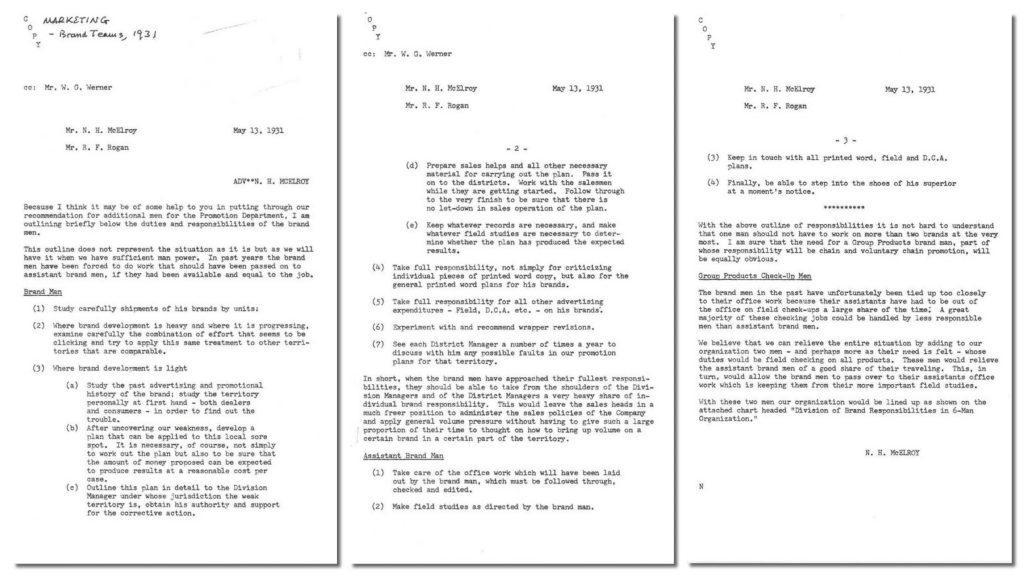
McElroy’s memo ran to three pages, which means the most famous P&G memo violated the famous P&G memo rule. This is exactly the kind of contradiction I love, because it reveals the real principle hiding inside the ritual. The page limit was never sacred. The thinking discipline was sacred. A great recommendation does not become great because it fits on one page. It becomes great because the writer has done the work required to make the choice clear.
In that sense, the P&G reco was an early management technology. It compressed context, judgment, evidence, economics, and action into a form that could travel through an organization. It turned vague business thinking into something visible enough to inspect. Once the thinking was visible, it could be challenged. Once it could be challenged, it could be improved.
That is why the reco still matters. AI has made it much easier to produce a memo. It has not made it easier to know whether the memo deserves to exist.
The reco was never really about the form
In the original post, I wrote that at P&G, decisions are made around the thinking structure of a recommendation. That was the important phrase: thinking structure. A reco is a way of deciding. The format matters because it creates discipline, but the value is not the boxes on the page. The value is the habit it creates in the person writing it.
You have to know what you want. You have to know why you want it. You have to know whether it is on strategy, whether it is proven, and whether it is cost effective. Then you have to put all of that in prose, in a way another person can use to approve, reject, or improve the recommendation. That sounds hard, and in the spirit of P&G precision, it is harder.
At P&G, everyone was expected to have a point of view. You could be wrong, and often you were. You could lack some of the data, and often you did. But you were expected to think the issue through and say what you believed the organization should do. That expectation was empowering because it treated junior people as future decision-makers. It was also exposing because your thinking had to stand on its own. A weak recommendation did not have many places to hide, especially once the memo had been reduced to one page and the adjectives had been marched out back for questioning.
I once rewrote a recommendation 27 times. I am sure I complained about it at the time. Everyone complained about rewrites. There is probably a secret P&G alumni support group somewhere where people sit in a circle and read old margin comments to one another. But I now understand that the revision process was not merely improving the document. It was improving me.
Each round forced the same basic questions: What am I really recommending? Why do I believe it will work? Is it on strategy? Is it proven? Is it cost effective? What happens next if this is approved? Those questions are easy to list, but they are hard to answer clearly, especially when you have only one page and a real decision at stake.
The revision was not separate from the thinking. The revision was the thinking.
Ogilvy understood the editor’s job
David Ogilvy once wrote, “I am a lousy copywriter, but I am a good editor.” He then described editing his own draft four or five times before it was ready to show to a client. I love that line because it takes the romance out of writing. Ogilvy was not describing a magical process in which perfect copy arrived fully formed from the heavens while a string quartet played softly in the background. He studied the problem. He gathered facts. He wrote alternatives. He threw away bad attempts. He edited the gush.
I am a lousy copywriter, but I am a good editor.
— David Ogilvy, letter to Ray Calt, 1955
There is something wonderfully human about that. Even Ogilvy, patron saint of the well-turned advertising sentence, described writing as a slow and laborious business. The work was not easy because he was gifted. The work was good because he kept working.
That is the part of business writing AI does not remove. If anything, AI makes it more important. The machine can reduce the pain of producing a first draft, but it cannot relieve the writer of judgment. A model can give you ten versions of a recommendation. Someone still has to decide which one is right. A model can summarize the arguments for and against a course of action. Someone still has to know whether the arguments are true, relevant, and sufficient. A model can make a paragraph sound better. Someone still has to ask whether the paragraph belongs there at all.
The great benefit of AI is that the first draft is easier. The hard work lies ahead.
Editing AI is not like editing yourself
At P&G, I learned to edit my own thinking. That distinction matters. I would write a reco, my manager would mark it up, and then I would go back into the document to find the real recommendation, sharpen the evidence, cut the throat-clearing, and remove the sentences I had inserted to make myself feel better about not yet knowing what I meant.
That process was painful, but at least the draft was mine. Its weaknesses were my weaknesses. If the recommendation was vague, that was because I was vague. If the proof was thin, that was because I had not done the work. If the background was too long, that was because I was trying to smuggle uncertainty into the document under the respectable name of context.
Editing AI is different. AI gives you the work of another writer. Worse, it gives you the work of another writer who is tireless, obedient, plausible, and utterly untroubled by the possibility that it may be wasting your time. A clumsy human draft often reveals where the thinking is weak. A polished AI draft can conceal the weakness under fluent prose, tidy headings, and a tone that suggests everything is under control.
Everything is not under control. The robot has simply learned memo voice.
The best analogy may be book editing. When you edit your own work, you are wrestling with your own mind. When you edit AI, you are editing another writer who has no memory, no stake, no embarrassment, no relationship with the reader, and no responsibility for the consequences of being wrong. That writer can be astonishingly helpful, but it cannot be trusted to know when the work is good.
That is your job.
What to look for when the draft already sounds finished
The hard part of editing AI is that the draft often looks closer to done than it is. It has the furniture of thought: a headline, a structure, a few reasonable claims, and a conclusion that sounds as if it has recently attended a leadership offsite. The editor’s job is to look past the furniture and inspect the foundation.
-
Look for fluent mush. This is language that sounds correct but does not change what the reader knows. AI is magnificent at fluent mush. It will tell you that a recommendation “aligns with strategic priorities,” “creates operational efficiencies,” and “supports scalable transformation,” which is impressive only if you have recently suffered a head injury or spent too much time reading enterprise software landing pages. A real sentence says which priority, which efficiency, whose operation, what scale, and what changes on Monday morning.
-
Look for fake balance. AI loves to make everything sound reasonable. It will give you a benefit, a risk, a mitigation, and a concluding sentence that says the decision should be made “thoughtfully.” This is true, in the same way that food should be edible and meetings should have a purpose. The editor’s job is to decide whether the tradeoff matters. A reco is not a civics lesson. It is a decision document.
-
Look for structure pretending to be thinking. AI will happily produce three pillars, five steps, seven principles, and a framework with a name that sounds like it came from an airport business book. Sometimes structure helps. Often it is just furniture. The test is whether the structure emerged from the argument or whether the argument was stuffed into the structure because the model knew that three of anything looks suspiciously credible in PowerPoint.
-
Look for unearned confidence. A human writer often hesitates when the data are thin. AI has no such instinct. It may present a soft pattern as a firm conclusion, or a plausible explanation as a proven cause. That does not make the model malicious. It makes it fluent. Fluency is not evidence, although it does look very nice in Arial.
-
Look for claims without provenance. P&G’s “proven” test becomes more important in the AI age, not less. Where has this worked before? What evidence supports it? What customer behavior, operating fact, competitive example, financial model, or ugly internal reality makes this recommendation believable? If the proof is missing, the sentence is not a claim. It is a wish wearing business casual.
-
Look for cadence contamination. This is the LinkedIn Morse code problem: short line, short line, manufactured pause, big-sounding claim, repeat until everyone needs a small lie-down. There is nothing wrong with a short sentence. There is something wrong with using white space as a substitute for thought. If the page looks like a hostage note with better kerning, combine the fragments and make the argument do the work.
-
Look for voice bleach. This is what happens when AI sands off the specificity, humor, irritation, and lived texture that make a piece sound like a person. The result may be professional, but professional in the way a conference-room wall is professional. Technically present. Spiritually unhelpful. The cure is not to add “personality” like parsley on a catered lunch nobody asked for. The cure is to restore the actual human standard: what I know, what I believe, what annoys me, what I have seen before, and what I am willing to defend.
-
Look for missing ownership. You can let AI draft the reco. You can let it challenge the reco. You can let it summarize objections, improve the subject line, and compress the background. But at the end, you have to be able to defend every sentence. If you cannot explain it in a meeting without looking back at the document, you do not own it yet.
Editing AI means finding the sentence that sounds finished but is only pretending to be a thought.
That is the difference between using AI and hiding behind AI. One is leverage. The other is just a very expensive way to produce FYI attachments.
HI + AI = OI
Before we more deeply inspect the process of creating this post, I think it is worth defining the meaning of intelligence here in the early 21st century. Some of the terms below are new, so I didn’t want them to come off like visitors roaming the hallways of this post without a badge.
HI is human intelligence. In the context of a reco, it is judgment, taste, lived experience, empathy for the reader, memory of how the business actually works, and the ability to make a call when two good arguments are competing for the same square inch of paper. HI knows what the organization can absorb. It knows what the decision-maker will challenge. It knows when a sentence is technically true but not useful. It knows when a recommendation is hiding because the writer is afraid to say the thing directly, which is a very human failure and therefore extremely common.
AI is artificial intelligence. In the context of a reco, it is recall, synthesis, comparison, structure, drafting, compression, and counterargument at a speed no human can match. AI can read the background, summarize the alternatives, draft the first version, generate objections, create a tighter subject line, and help pressure-test whether the recommendation is on strategy, proven, and cost effective. That is real leverage. Anyone pretending otherwise is probably still printing out emails and calling it a workflow.
But the goal is not HI over here and AI over there, with the human occasionally poking the machine and then pretending the output is “collaboration.” That is tool usage. Useful, but limited.
The goal is OI: One Intelligence. In the Firm of the Future, HI and AI will stop operating as parallel systems and start operating as one integrated intelligence. Human intelligence supplies judgment, taste, empathy, and responsibility. Artificial intelligence supplies memory, synthesis, recall, drafting, comparison, and structure. Together they create an operating intelligence that can think across more material, test more alternatives, and still end with a human-owned decision.
In the narrower world of the P&G reco, OI has a very practical meaning. It is the intelligence that turns a fast AI draft into a better recommendation. The machine expands the field of possibilities. The human narrows the field to what is true, useful, and worth approving. The outcome is not more words. We have plenty of words, thank you. The outcome is a reco that helps the organization make a better decision.
HI + AI = OI.
— Human judgment plus machine intelligence, integrated into one operating intelligence
That is the standard. Not “did AI write this?” Not “did the human write this?” The better question is whether the combined system produced a clearer, sharper, more defensible recommendation than either would have produced alone. I am sick and tired of being asked “who wrote this?” From now on I only have one answer: “We did.”
This post is the example, unfortunately for both of us
This post has already gone through several rounds of HI and AI, and the process has been annoying in exactly the right way. It is also a small example of OI at work: not because the machine produced a perfect draft, which it very much did not, but because the human-machine system kept improving under editorial pressure.
I started with the idea: write a sequel to my P&G reco post for the AI age. AI produced a first draft quickly, which is the part AI is supposed to do. The draft had some useful raw material, which is also the part AI is supposed to do. Then it failed in the part that matters most: it did not sound like me, it did not have enough specificity, and it had the emotional texture of a dish towel.
So I edited. More accurately, I complained, which is often the beginning of editing if you are honest about it. I said it sounded like a machine gun. I said it was Grease II when the assignment was Godfather II. I said to stop writing in that staccato LinkedIn style that is slowly turning the internet into a hostage note with better kerning. I told it I was disappointed in its efforts, and that for a supposedly superior intelligence it sure wasn’t impressing me.
As an aside, I am having one of the most refreshing and rewarding periods of my life as a writing coach in that I can finally tell the writer how I really feel about their work. I’m letting my HI flag fly, and it feels so good to really let AI have it every once in a while. Quite frankly, this is the way I was trained … but it’s no longer appropriate in the workplace. But with AI? We’re right back to radical candor and wow does it ever cut through the crap. Very refreshing. My only fear is that Claude starts reporting me to AIHR for being mean.
The next draft improved, but not enough. That is also the point. AI did not magically become right because I gave it feedback once. It got closer. Then I had to supply more judgment. Add the history of the one-page memo. Add the McElroy memo. Add the distinction between editing your own work and editing AI as another writer. Add the practical guidance. Add the Markdown file. Add the sarcasm, because apparently the machine had mistaken “business essay” for “humorless compliance document.”
So, who wrote this? The answer is both, but not in the lazy way people usually say “both.” AI generated drafts, alternatives, structures, and raw material. It helped find sources and organize the argument. It was fast, tireless, and occasionally useful, which is more than I can say for some meetings I have attended.
But HI supplied the standard. HI rejected the wrong voice. HI knew the draft was off before the problem was fully articulated. HI asked for the historical flourish. HI noticed the missing AI-era editing guidance. HI insisted that the piece needed to sound like it had been written by a person with taste, memory, irritation, and a pulse.
That is the AI/HI equation. AI creates options. HI creates meaning. AI gives you something to edit. HI decides what survives. When it works, the result is not AI writing and it is not human writing in the old solitary sense. It is edited intelligence: machine-generated possibility shaped by human judgment.
And as P&G taught me, the editing is not what happens after the thinking. The editing is the thinking.
The Markdown file is part of the work
One practical lesson from this process is that “write more naturally” is not a good enough instruction. AI needs constraints, but the constraints have to be specific. A vague style preference produces a vague improvement. A good editing file gives the model a standard it can apply before it gives you a draft.
I now think of this as part of the modern writing process. Not because a Markdown file is magical. It is not. It is just a document, which means it can be ignored, misread, or turned into a new source of bureaucratic sludge if left unattended. We are still in business, after all.
The point is that the file makes the standard explicit. It tells the model what kind of writing is unacceptable, what kind of evidence is required, where sarcasm belongs, where it does not, how to use history, and how to know whether a sentence sounds like me or like a machine trying to sound like a business writer. The full file can live as a working instruction document. The part that belongs in the post is the portable version: the part a reader can steal.
# Copernican Shift AI Editing File

Start from something real: a work experience, historical artifact, business ritual, irritation, or pattern the writer has actually noticed.

Write in complete paragraphs. Do not use LinkedIn staccato, false suspense, or paragraph-per-sentence formatting.

Find the category error: what are smart people confusing?

Use history only when it changes how the reader sees the present.

Add sarcasm where the piece identifies a false belief, bad corporate habit, vague marketing, committee residue, or AI filler. Do not sprinkle jokes randomly.

Mark every claim. What supports it: lived experience, a source, a number, a customer behavior, a historical artifact, or operating logic?

When editing AI, assume the draft came from a talented but unaccountable writer. It may sound finished before the thinking is done.

Look for fluent mush, fake balance, structure pretending to be thinking, claims without provenance, cadence contamination, voice bleach, and missing ownership.

Before publishing, ask: could another thoughtful CMO have written this exact piece? If yes, it is not done.
That file does not write the post. It gives the editor a fighting chance.
How to use AI to write a better reco
If I were writing a P&G reco with AI today, I would not begin by asking the model to write the final memo. That gives the machine too much authority too early. I would start by explaining the situation in plain language: the business problem, the audience, the decision needed, the relevant constraints, and the evidence available. I would also include my current point of view, even if it was messy. Especially if it was messy.
Then I would ask AI to help me think. What are the strongest possible recommendations? What are the tradeoffs? What evidence would support each path? What would a skeptical CFO challenge? What would an operator worry about? What would a customer not care about? What would make this recommendation fail?
Only after that would I draft the reco. AI could help with the draft, certainly. But once the draft exists, I would stop treating the model as a writer and start treating it as an editing partner. The editing would happen in passes, because “please make this better” is not an editing instruction. It is a wish, and we have already established that wishes wearing business casual are not strategy.
-
The recommendation pass. What are we actually asking someone to approve? If the answer cannot be stated in one sentence, the memo is not ready. The recommendation should contain a decision, not a topic. “We should pilot AI customer support” is not enough. “We should pilot AI customer support for tier-three billing inquiries in Q3, capped at $150,000, with success measured by resolution time, customer satisfaction, and escalation rate” is closer.
-
The evidence pass. Every claim needs a basis. That does not mean every sentence needs a footnote, but it does mean the editor has to know why the sentence is there. Is the claim supported by data, customer research, past experience, a competitive benchmark, or operational logic? If not, the sentence may simply be confidence wearing a suit.
-
The specificity pass. Replace category language with operating language. AI will often write that a recommendation “improves efficiency,” “enhances customer experience,” or “aligns with strategic priorities.” The editor has to translate those phrases into something a business can inspect. How much efficiency? Which customer? What experience? Which strategic priority? What changes on Monday morning?
-
The alternatives pass. A good recommendation is not a favorite option dressed up as destiny. Ask AI to argue against the recommendation. Ask it to make the best case for doing nothing. Ask it to identify the hidden cost, the organizational risk, and the stakeholder most likely to object. Then use that critique to make the recommendation more honest.
-
The compression pass. AI expands naturally. Good business writing usually contracts. This is where the P&G one-page discipline becomes useful again. Cut the context the reader already knows. Cut the sentence that merely introduces the next sentence. Cut the balanced phrase that sounds smart but does no work. Cut the hedge that protects the writer but weakens the recommendation.
-
The voice pass. The final reco should sound like a person who understands the business and is taking responsibility for a decision. It should not sound like a machine trying to be reasonable. If the memo contains no sentence that reflects the writer’s actual judgment, the memo may be polished but it is not owned.
-
The approval pass. Read the memo as the decision-maker. What would you approve? What would you reject? What question would stop you? What would you need to know before saying yes? A reco is not finished when the writer is done writing. It is finished when the reader can use it.
That workflow is not about making AI less useful. It is about making AI useful in the right role. The model can generate, challenge, summarize, and compress. The human still has to decide.
Human intelligence is not decoration
One last thought on this whole HI + AI idea. The common mistake in AI writing is to treat human intelligence as a final layer of polish. The model writes, the human tweaks. That is backwards. Human intelligence is not decoration. It is the source of intention, taste, memory, skepticism, humor, and responsibility.
AI can draft a paragraph about P&G’s recommendation culture. It cannot remember being a young brand manager trying to get a memo approved. AI can explain the value of editing. It cannot feel the irritation of reading a draft that sounds smooth and empty. AI can summarize the McElroy memo. It cannot know why that historical aside belongs in this essay unless a human recognizes the connection.
This is where HI adds value to AI. Human intelligence supplies lived context. It knows what the reader already understands and what they need explained. It knows when a joke sounds like the writer and when it sounds pasted in. It knows when a sentence is true but not yet useful. It knows when the model has produced a plausible structure that does not actually fit the thought.
The goal is not to make AI sound more human by sprinkling in quirks. That is ventriloquism, and usually not very good ventriloquism. The goal is to use AI to expand the range of possible expression while using human judgment to decide what deserves to survive.
That is how HI + AI can equal 3. AI creates abundance. HI creates meaning. AI produces options. HI makes choices. AI accelerates drafting. HI protects judgment. Together they can produce better work than either would produce alone, but only if the human refuses to abdicate the editor’s role.
Without that refusal, AI does not give us better writing. It gives us more writing, and more writing is not the problem we needed solved.
The reco still belongs to you
A recommendation culture teaches people to have a point of view. An editing culture teaches people to make that point of view better. The two belong together. A recommendation without editing can be sloppy, political, or premature. Editing without recommendation can become endless refinement without a decision. The goal is not to polish forever. The goal is to improve the thinking enough that action becomes possible.
That is why the old P&G reco is such a useful model for the AI age. It is short, but not shallow. It is structured, but not bureaucratic. It creates room for judgment while forcing the writer to make choices. It gives management what management needs: a clear recommendation, a basis for believing it, and a path to action.
In a world where everyone can generate a first draft, the ability to edit that draft into a real recommendation will become one of the marks of serious professionals. Not because editing is fancy. Not because one-page memos are sacred. But because organizations still need people who can think clearly, write clearly, and take responsibility for what they believe should happen next.
AI can draft, challenge, summarize, compress, and suggest. It can give a brand manager six launch options before lunch. It can give a CMO three ways to frame a board recommendation before the second cup of coffee. It can make the first draft easier, which is no small thing. But it cannot own the recommendation because the reco still belongs to you.
Your approval, please.